
Possible Preaching Themes
Possible Scientific Resources
- Theme 1: Coexistence and Divine Patience
In the parable of the wheat and weeds, God permits evil and good to grow together.
What does it mean to trust God's timing when injustice endures? How does patient faith
differ from passive acceptance? - Theme 2: The Hidden Kingdom and Small Beginnings
The mustard seed does not ask permission to grow. In many underserved
neighborhoods, community members have been converting vacant lots into gardens for
years, without waiting for a city plan or a developer. - Theme 3: The Unequal Weight of a Fallen World
Scripture consistently reveals that the burdens of a broken creation fall unevenly upon
the most vulnerable. How does the Gospel call us to name and address this inequality?
- Theme 1: Coexistence and Divine Patience
- In this research paper from the United Nations, a leading voice in environmental justice explores how environmental racism impacts disadvantaged populations.
- This public health study demonstrates that air pollution exposure is significantly and disproportionately higher for racial minority populations in urban centers.
- This municipal strategy document outlines the historical data showing uneven distribution of stormwater management and investment across urban neighborhoods.
- Theme 2: The Hidden Kingdom and Small Beginnings
- Risk Reduction: This report details how small-scale infrastructure projects, when deployed at the park level green, measurably reduce localized flood risk and water
pollution. - Macro Climate Impacts: This article outlines the benefits of urban green infrastructure.
- Heat and Runoff Mitigation: This article quantifies how localized interventions like green roofs and rain gardens significantly mitigate the urban heat island effect.
- Risk Reduction: This report details how small-scale infrastructure projects, when deployed at the park level green, measurably reduce localized flood risk and water
- Theme 3: The Unequal Weight of a Fallen World
- Resilient Housing Barriers: This resource explores the direct link between outdated housing policy, climate vulnerability, and localized environmental injustice.
- Generational Inequality: This sociological study documents the rigid, multi-generational persistence of neighborhood-level environmental inequalities.
- The Legacy of Redlining: This article describes the structural, state-sanctioned history of redlining and segregation that remains physically visible in modern municipal infrastructure.
Homily Outline Combining Resources
Homily outline: Infrastructure Justice and God’s Patience
- Introduction
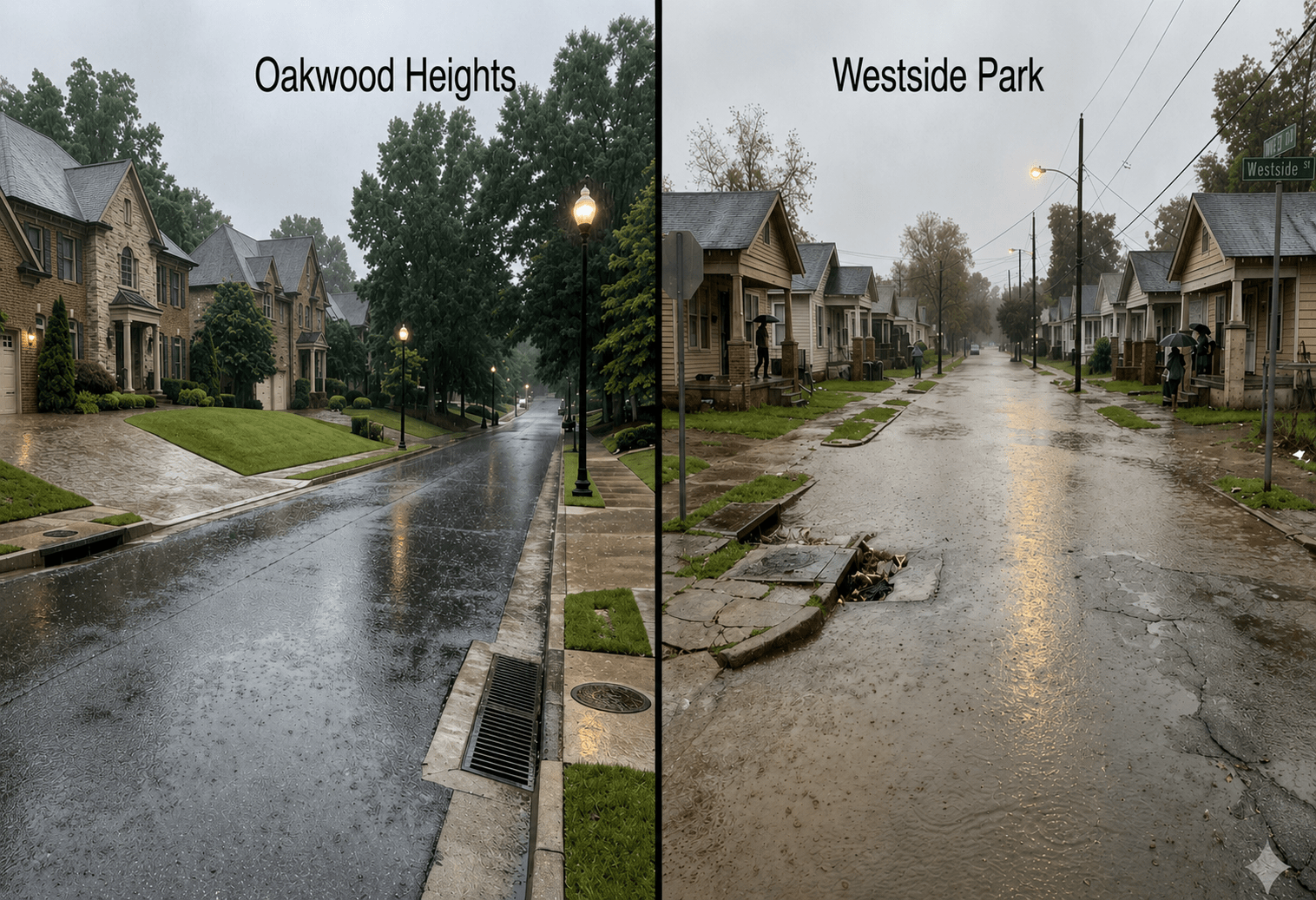
- In many cities, the same rain falls differently depending on the neighborhood. In one district, stormwater disappears quietly into well-maintained drains. A few kilometers away — in a neighborhood that has historically received less investment — that same rain floods streets, fills basements, damages buildings. Same city. Same rain. Different infrastructure.
- In Jesus’ parable (Mt 13:24-43), the householder waits with patience and does not act in haste. For an engineer, patience means understanding how the system actually works.
- Planning that is patient and attentive to place creates conditions for flourishing across generations. Planning that moves in haste, or that ignores the voices of the vulnerable, leaves marks that outlast any single decision.
- Infrastructure Is Not a Decision, It Is a Theology
- Major infrastructure decisions of the mid-twentieth century — highway routes, zoning boundaries, investment corridors — were technical decisions but carried theological consequences: air quality, flood risk, property values, school funding.
- Polluting facilities have been systematically concentrated in minority neighborhoods.
- Across the United States, air pollution burden is disproportionately higher in racial minority neighborhoods.
- Today Paul teaches that “creation has been groaning in labor pains together until now.” That groaning has a specific address: in every city where infrastructure was built to protect some neighborhoods and neglect others.
- Suffering itself is not the only scandal here — it is that the suffering was designed. Infrastructure does not flood neighborhoods by accident. It floods the neighborhoods it was never built to protect.
- Wheat and Weeds: Patience and Planning
- The parabolic instruction to let weeds and wheat grow together is not indifference.
- Small interventions can transform the existing system gradually through rain gardens, green roofs, and permeable paving.
- In Berlin, designing 30% of each building as green space creates measurable climate resilience within a decade.
- The mustard seed does not ask permission to grow: In many underserved neighborhoods, community members have been converting vacant lots into gardens for years, without waiting for a city plan or a developer.
- Vegetation reduces surface temperatures, slows runoff, and rebuilds soil. The science confirms what the parable teaches.
- You do not need a grand strategy to begin., only a seed, a patch of neglected ground, and the patience to tend what others have written off.
- Creation Does Not Groan Equally
- When Laudato Si’ asserts that ‘The cry of the earth and the cry of the poor are one,’ it is not speaking in the abstract.
- Environmental justice is also a housing issue, a climate issue, an infrastructure issue.
- The neighborhoods that flood are the same neighborhoods that have always flooded. The neighborhoods with the worst air are the same neighborhoods that were redlined, cut off by expressways, passed over by every investment cycle.
- The traces of redlining are not historical footnotes. They are visible in the infrastructure of underserved neighborhoods in cities across the world.
- The Spirit intercedes with ‘groanings too deep for words.’ A geotechnical engineer learns early that what is buried does not disappear. The ground eventually tells the truth.
- The householder’s patience is not consent to the status quo. It is preparation for justice.
- Conclusion
- When it rains on neighborhoods that have been systematically underserved, it is necessary to look not only with the eyes of an engineer but also with the eyes of a practical theologian.
- Infrastructure decisions are ultimately decisions about human dignity; who deserves protection, whose neighborhood is worth investing in, and whose suffering is deemed acceptable.
- Planting a rain garden is more than capturing stormwater. It is saying to a neighborhood: you matter too.
- At harvest time, it will ask: What did we sow: Concrete, or soil? A wall, or a garden? A line on a map, or justice?
Related Homily Outlines
16th Sunday in Ordinary Time, Year A
16th Sunday in Ordinary Time, Year ALectionary 106: Wisdom 12:13, 16-19 Psalm 86:5-6, 9-10, 15-16 Romans 8:26-27 Matthew 13:24-43[dipi_advanced_tabs...
Yunus Emre Tozal
[dipi_floating_multi_images _builder_version="4.27.6" _module_preset="default" custom_margin="||||false|false"...
Couldn’t find what you’re looking for?
Try searching with another filter
Preaching with Sciences

Edward Foley, Capuchin
Duns Scotus Professor Emeritus of Spirituality
Professor of Liturgy and Music (retired)
Catholic Theological Union
Vice-Postulator, Cause of Blessed Solanus