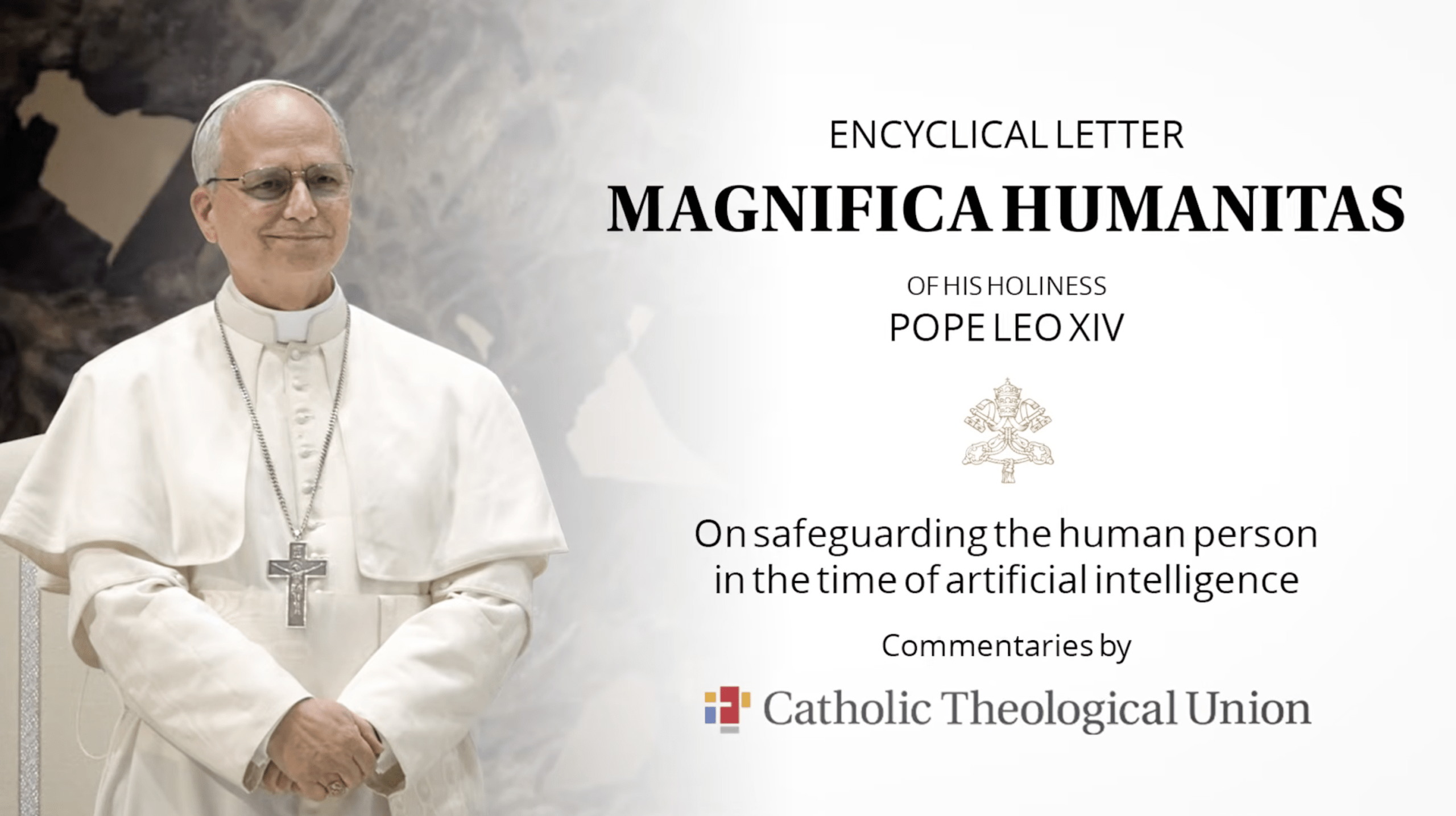
As when Pope Francis released Evangelii Gaudium and Laudato Si’, now the CTU faculty offer theological reflections on Pope Leo XIV’s encyclical letter, Magnifica Humanitas.


Seven members of CTU’s full-time faculty offer reflections on seven different dimensions of Magnifica Humanitas in ways that will become part of how theology and ministry are taught at Catholic Theological Union.


We hope you will listen and reflect on Magnifica Humanitas with us, and then support us at CTU while we work with our students every day to bring Pope Leo’s bold and faithful vision to life in our world.


“Pope Leo XIV’s words are more than an apology. They are an invitation to truth-telling, repentance, and transformation. For Black Catholics, this acknowledgment of the Church’s complicity in slavery affirms what generations have known, endured, and proclaimed. The wound is real. The memory is painful. Yet the faith of Black Catholics has remained steadfast.”

– Dr. C. Vanessa White

“The social doctrine of the Church is not something extra in Catholic faith. Catholic social teaching’s principles for living as Christian believers in the world have deep roots in the writings of Thomas Aquinas, Augustine, and most of all in Scripture. Pope Leo wants us to know they are an integral part of the Catholic Tradition, even though we don’t talk about them as much as we should.”

– Dr. Steve Millies

“Leo calls us out of passivity, complacency, and resignation with a metaphor rooted in  labor — manual labor. To go get our hands dirty is an appeal to respond with an invested,  exertive, and embodied participation. What does it mean to get your hands dirty in an era of  digital transformation?” 

– Dr. Carmen M Nanko Fernández

Jerusalem offers an alternative model. After destruction and exile, the city is rebuilt through cooperation among families, workers, priests and civic leaders. Each group contributes according to its abilities, and diversity is directed toward a common purpose. Leo XIV emphasizes that Jerusalem is reborn through “shared responsibility,” making it a symbol of how society should approach AI.”

– Fr. Enzo Del Brocco, CP

“When it comes to religious and theological studies, or when it comes to generating knowledge about religious traditions for interreligious dialogue, A.I. can be problematic because of its biases, and its pursuit of maintaining the attention of a user by reasserting a user’s biases. Given the scourge of anti-Muslim bigotry and anti-Semitism permeating our society, a person runs the risk of interacting with A.I. that has the very real potential of reaffirming anti-Muslim bigotry and anti-Semitism, among other forms of religious hate. So the question one has to ask is: what do we do?”

– Dr. Syed Atif Rizwan

Our world is filled with attempts to seize control of markets and spheres of influence…”  So writes Pope Leo XIV in the Conclusion of his first encyclical Magnifica Humanitas.   Throughout the document he insists that humankind, the magnificent creature made in the image of God, is charged with bringing forth the reign of God within that world.  But how is the responsibility to be accomplished?  In the way our ancestors set out to build the tower of Babel?  Or the way a later generation sought to restore the city of Jerusalem.”

– Sr. Dianne Bergant, CSA 

“The frailty, the vulnerability, the ambiguity, and the imperfection of being human;  these are not unfortunate byproducts of original sin but rather gifts from God imbued in the very fashioning of us as God’s beloved sons and daughters.  We grow, we make mistakes, we learn, we seek repair, and to make a more just, more beautiful, and more humane social order that can be in tune with our ecological home.”

– Dr. Kevin Considine

Magnifica Humanitas

Summer @ CTU

The CTU faculty offers theological reflections on Pope Leo XIV's new encyclical, Magnifica Humanitas